
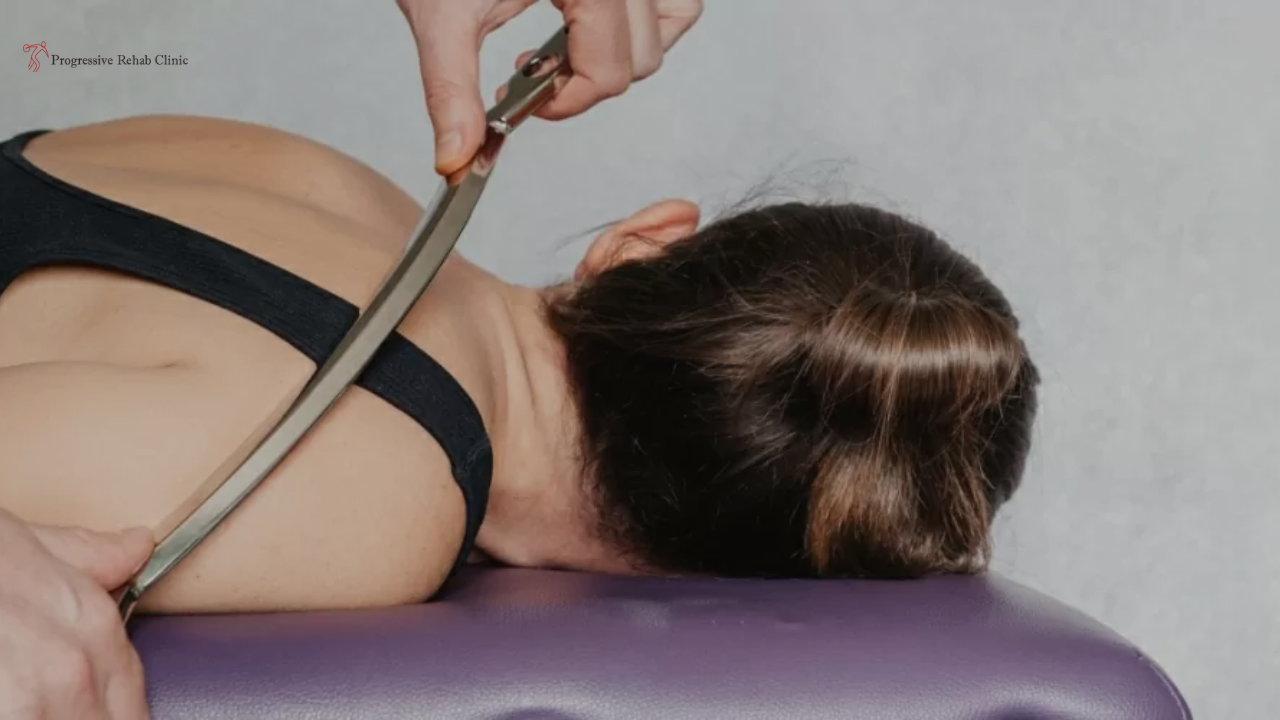
Let us talk about the Graston Technique. You have probably heard the name and wondered what it means. It sounds technical, but the idea is really quite simple. It is a type of therapy that uses special stainless steel tools to treat muscle and soft tissue problems. Imagine you have a knot in a rope. You can try to untangle it with your fingers, but sometimes you need a tool to really work it loose. The Graston Technique works the same way. Instead of just using their hands, therapists use smooth, contoured tools that are shaped to fit the curves of your body, like your shoulder, your back, or your leg. The goal is to find areas in your muscles or tendons that feel thick, sticky, or tight. At Progressive Rehab Clinic, our trained therapists use this technique to help people finally get relief from stubborn muscle pain.
How Does the Graston Technique Work?
Think about what happens when you injure a muscle or overuse it for years. Sometimes it heals with tissue that is thick and sticky, like a tough knot. This is not flexible, healthy muscle anymore. It is restrictive, and it can pull on other areas, causing pain and limiting your movement. The goal of the Graston Technique is to find these restrictive areas, break up that dense tissue, and encourage your body to heal the spot again with fresh, supple tissue. A trained therapist will glide the tool over your skin with gentle pressure. When they move over healthy muscle, it feels smooth. But when they find one of those tight, gritty spots, often called adhesions or scar tissue, you will feel it. At Progressive Rehab Clinic, our therapists use this feedback to pinpoint the exact source of your problem.
What Does the Treatment Feel Like?
This is what most people want to know before they try it. You will feel pressure, and a deep, spreading sensation as the tool moves across your skin. When it crosses a particularly tight knot, it will be intense. Most people describe it as a good hurt, the kind of deep pressure you feel when a really tight muscle is finally getting worked on. It should not be a sharp or stabbing pain. A good therapist will communicate with you the whole time, making sure the pressure is effective but tolerable for you. It is common for the area to look a bit pink or red afterward, similar to a mild sunburn. You might also feel some muscle soreness the next day, like after a new workout. This is a normal part of the process as your body responds to the treatment.
What Conditions Can It Help?
The Graston Technique is excellent for chronic, nagging issues that have not resolved with standard care. It is often used for tennis elbow or golfer’s elbow, those stubborn pains from repetitive gripping or lifting. It works very well for plantar fasciitis, that sharp heel pain in the morning. Runners often benefit from IT band syndrome, the tightness on the outside of the knee. Shoulder impingement or rotator cuff issues also respond well, especially when scar tissue is limiting your range of motion. The technique is also great for breaking up scar tissue from old injuries or surgeries. If you have a tight, painful area that massage and stretching have not fixed, the Graston Technique might be what you need. At Progressive Rehab Clinic, we can assess whether this technique is right for your specific condition.
The Most Important Part: It Is Not Magic
Here is the key thing to understand about the Graston Technique. It is a tool, not a cure all. A reputable clinic like Progressive Rehab Clinic would never just use the tools and send you on your way. The technique is used to prepare the tissue. It breaks up the restrictions and increases blood flow to the area. But what you do next is everything. This is where your active role comes in. After the treatment, your therapist will give you specific exercises and stretches to do at home. These movements are absolutely crucial. They retrain your muscles to function properly now that the restrictive tissue has been addressed. The tool based therapy creates the opportunity for healing, and your exercises make the results last. Without the exercises, the tightness will likely come back because your muscles have learned to move in a certain way.
The Bottom Line on the Graston Technique
If you have an ache or a tightness that feels stuck, that has not improved with regular massage or stretching, the Graston Technique could be a helpful approach to explore. It offers a different pathway to reach deep seated tissue problems that hands alone cannot always access. The tools allow your therapist to be more precise and apply consistent pressure without fatiguing their hands. Many people find that a few sessions of Graston, combined with the right exercises, finally resolve problems that have bothered them for months or years. If you are curious whether the Graston Technique could help you, the best step is to have a conversation with a qualified physiotherapist. At Progressive Rehab Clinic, we will assess your specific situation and build a treatment plan that makes sense for you.